Matryoshka: An International Love Affair
Written by Vadim on February 27, 2009 – 12:00 am -Matryoshka: An International Love Affair
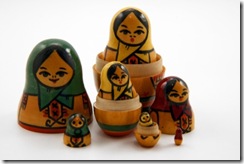 Perhaps the best known Russian toy, matryoshka, or wooden nesting dolls, are a relative newcomer to the world of Slavic toys. Although nesting toys in the shape of an egg or ball have been popular in Russia for centuries, nesting dolls first came to the country as a souvenir from Japan in the late nineteenth century. Since then, matryoshka have become one of the most beloved symbols of traditional Russian culture.
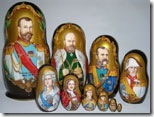 Like the egg shaped toys preceding Matryoshka, nesting dolls are traditionally made with a lathe with the inner most doll created first. They are then painted, usually to resemble women and girls in traditional Eastern European dress. However, not all matryoshka are feminine. Nesting dolls have been made to resemble birds, characters from popular folk tales, and even Communist leaders of the twentieth century.
The most remarkable feature of matryoshka is usually the elaborate painting. Regardless of the theme or type of characters, Russian nesting dolls are painted in vibrant colors, then heavily varnished. The designs are usually reminiscent of traditional agrarian Russian culture.
The name ‘Matryoshka’ has its own colorful history. At the time that nesting dolls became popular in Russia, Matryona was a widespread female name, with Matryoshka the most common nickname. In addition, the name Matryona comes from ‘mater’, the Latin word for mother. Because the dolls had a maternal theme, with several females nested inside each other, this name took hold in Russia and is now internationally recognized.
During the Soviet era, traditional matryoshka dolls became rare enough to be almost an endangered species. The government did not allow the sale or display of handicrafts. Although there were matryoshka factories, the dolls made there had to be manufactured in an efficient, assembly line manner that took the warmth and uniqueness from this traditionally handmade toy and made more traditional, complicated designs impossible. Although some toys were illegally made and exported throughout this time, handmade and hand-painted nesting dolls from Russia were not commonly available until after the fall of the Soviet Union.
Matryoshka dolls have a variety of uses in the modern world. They remain beloved toys for children and the young at heart all around the world. Nesting dolls can also make a quaint yet cultured addition to home decoration. They have been used as promotional items from companies and even as invitations to weddings. Matryoshka bring a distinctively Eastern European flavor wherever they appear.
Matryoshka dolls have become not just a recognizable symbol of old Russia, but a metaphor as well. The word ‘matryoshka’ is often used to describe like items neatly nesting inside each other, such as makeup kits or storage containers. They have made their mark in every field from astroengineering (“The Matryoshka Brain”) to children’s television (“Higglytown Heroes”). This may be due to the enduring nature of a nesting doll. Like these distinctive nesting dolls, we all have multiple layers just waiting to be discovered. Perhaps this is the true reason matryoshka nesting dolls have captured hearts all over the world. 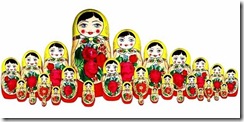
References:
http://en.wikipedia.org/wiki/Matryoshka
http://www.madehow.com/Volume-6/Matryoshka-Doll.html
http://www.angelfire.com/art2/petrikovka/matryoshkahistory.html
Tags: matryoshka doll, toys
Posted in General | No Comments »
Russian Toys in My Childhood
Written by Vadim on September 24, 2008 – 6:01 pm -I was raised in Australia, but my parents came from the Soviet Union in the early 70’s. When I was 3 years old, my grandmother moved to Australia to join our family after her husband died.
She wanted her grandchildren to have exposure to Russian Culture. She used to read to me from Russian Childrens books. I could not read the Cyrillic script, but I enjoyed looking at all the pictures, which were hand-drawn in such great detail and with a distinctive style, unlike the comics I had and the Saturday Morning cartoons I used to watch on TV.
My favourite was a red wooden doll. Only recently, did I discover that the proper name is a Matryoshka doll. I always felt intrigured when I pulled the torso off to find another identical figure, just a bit smaller. There were six in total, and it was slightly disappointing to me that the smallest could not be opened up to reveal anything more. I may have spent hours compulsively opening the dolls and putting them back together – lining up my ‘army’ of six, then turning them back into one. I guess in many ways they are comparable to Transformers – “They’re more than meets the eye”.
Tags: dolls, matryoshka doll, toys
Posted in General | No Comments »